The Artist as Scientist: Resilience and Healing in Lai Dieu Ha's Practice
ISSUE NO.2
Vi Bui


In the intimate, overcrowded space of Nha San Studio [1] on a December evening in 2010, Lai Dieu Ha (b. 1976) pressed a hot iron against pieces of pig skin, the smell of burning skin filling the room as audience members shifted uncomfortably in their seats. Some fled; others watched in horrified fascination. This is "Hurt in Here," a performance that would later become one of the artist's most significant works, marking both a culmination of her early confrontational approach and, paradoxically, the beginning toward what Lai now calls "soft politics."
Since graduating from Hanoi Fine Arts University (now Vietnam University of Fine Arts) in 2005, Lai has established herself as one of Vietnam's most compelling performance artists, using her body as what she calls "a material, a living archive." Alongside "Hurt in Here" (2010), her work spans from the provocative "Flying Up" (2010), where she appeared unclothed, covered in feathers and glue, and seemingly tried to swallow a bird alive but only for a few seconds before releasing it from her mouth, to her current practice, which increasingly incorporates painting and "soft sculptures" as means to extend and reflect upon her performative explorations. These tactile, organic forms, sometimes wearable designs under her independent brand RAI, embody a softer, more reflective dimension of her exploration of the body, memory, and resilience.
The foundation for this artistic journey was laid early. Her father, Lai Thanh, was a propaganda painter during the subsidy period, creating works that celebrated "Workers, Farmers, Soldiers" and their labor and production. Lai grew up surrounded by his propaganda posters that marked the early period of development in Northern Vietnam. She recalls not just drawing everything she saw, but mischievously scribbling mustaches on Soviet leaders like Mikhail Gorbachev and Lenin in her father's magazines. At age eight, she used a Soviet magnifying glass to study hydra by the pond, creatures that would later become a childhood obsession appearing in her projects "Clinging Hybrid" (2012) at the Goethe Institut, Hanoi and "Conservation of Vitality" (2015) at CUC Gallery, Hanoi. Where her father's work served clear ideological purposes, her practice has always embraced what she calls "psychological blurriness," a deliberate ambiguity that forces viewers to confront their own assumptions about art, the female body, and creative expression.
Lai's painting practice is deeply intertwined with her performance work. Rather than treating painting as a separate medium, she uses it to prolong the psychological impact and material presence of her performances. Her canvases often depict or reference moments from her own performances and those of her peers, transforming ephemeral actions into lasting visual narratives. Through this process, painting becomes a form of archival research and reflection, allowing her to explore the body, memory, and trauma in a new, layered dimension.
Now, as she prepares for a solo exhibition at Galerie Quynh in Ho Chi Minh City in March 2026, Lai describes herself as undergoing what she calls a deliberate "reset" of her entire career. "I'm becoming a scientist researching my own extended practice within the social context," she explains, approaching her artistic legacy with the analytical distance of a scholar. She's currently painting approximately twenty new works while systematically reviewing her archive of videos and documentation, seeking to understand not just what she has created, but why, and what it means for the broader landscape of Vietnamese contemporary art.
This shift is a fundamental reimagining of performance art, extending beyond artistic evolution. Where her previous work tested the limits of physical and psychological endurance, her current approach seeks to create what she calls "conditions for healing" rather than spaces of shock or discomfort. This transformation reflects broader questions about the role of performance art in her view: Can it serve therapeutic functions alongside purely aesthetic ones? And how does an artist maintain a critical edge while embracing healing and community?
This painting is derived from the performance video "Beautiful" (2011), originally staged at Nha San Studio. In the performance, when the artist bent down it was toward thirty-six eggs; in the painting, the gesture transforms into flowers. By shifting the symbolic material, the work reimagines the act as one of personifying beauty and symbiosis, extending the performance’s ephemeral action into a lasting pictorial form.
Currently, Lai Dieu Ha has taken this philosophy even further, integrating performance art into her everyday life and work, blurring the boundaries between art, artwork, and personal existence. "My teaching, my studies [2] - everything is performance. I myself perform small social reflections within a larger social context, something that any individual or institution finds extremely difficult to grasp in today’s shifting times," she shares. In the near future, she plans to expand her practice into healthcare contexts, collaborating with children to explore the therapeutic potential of art.
I spoke with Lai as she prepared to join VAC's November 2025 residency program as a guest artist alongside artist-in-residence Dang Thuy Anh. Through our conversations, I've come to understand an artist who has learned to wield ambiguity not as a means of confrontation, but as a mechanism for creating space for reflection. "I want to become someone wise and objective enough to examine my entire body of work," she says, describing her current state as fundamentally different from the "passionate, tormented" artist who made those performances more than a decade ago.
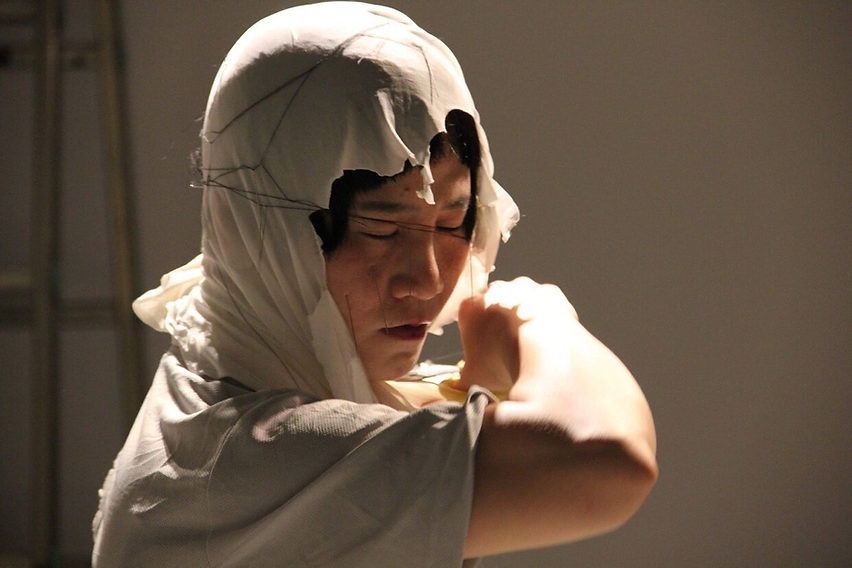
In this silent performance, the artist used a compass needle (kim chỉ bắc) to trace and locate coordinates, reinterpreting the phrase “kim chỉ nam” (guiding principle) as “kim chỉ bắc” (North compass), extended toward the North. The work explored subtle gestures of self-orientation, mapping, and re-mapping history through the body.
Derived from video stills of earlier performances, this painting series revisits and reinterprets the artist’s personal actions through the visual language of propaganda posters. Emphasizing symbolic qualities and declarative urgency, the works inherit the spirit of performance while extending it into painting. In doing so, they trace a continuity between ephemeral bodily acts and the enduring, rhetorical force of poster art - bridging performance and propaganda across time.
、
Q&A between the artist and the author
Q: You've spoken about becoming "a scientist researching my own practice." What led to this shift in how you see your role as an artist?
A: After "Hurt in Here," I was burned, both physically and emotionally, and realized I was causing myself real harm. I remember going backstage and meeting artist-curator Tran Luong. I immediately said: "I will stop the pain performances, stop cutting my body here. I am really in pain." Some people regretted it, saying I'd lost my edge, lost my energy.
But I wasn't afraid. I wanted to go deeper and ask: where does that "pain" come from? Is it the female body under tradition and social prejudice, or am I an independent individual observing societal psychology? Today, I can step back and analyze my work with greater objectivity.
Q: Your relationship with materials seems central to your practice. How do you know when a material is "speaking" to you conceptually?
A: I look for what I call "the intelligence of the material" combined with the reflection of context, personal and social circumstances at each moment. Take pig skin, for instance. In "Hurt in Here," I became "The Pig," empathizing with the pig by dissecting layers of skin: dry, fresh, scraps, slimy pieces. I was like an anatomist, but actually, it's about empathy and respect for the pig. Over time, the material migrated from performance to painting to soft sculpture. Pig skin is slippery and full of contradictions, like the judgments society makes about what is clean or dirty, acceptable or shameful. It holds resilience within it, and it keeps asking questions.
Q: How do you translate the ephemeral nature of performance into the permanence of painting?
A: Most canvases are 1m x 1.55m (that's my height), corresponding as a metaphor for a living, performing body that can be doubled or multiplied. Smaller paintings usually depict personal performances, moments I want to slow down, pause, or examine from my past work. When I double the size to 2m x 1.55m, I project outward to Psyper/Lab [2] and broader social contexts, where my individual performance plays one role among many. These larger paintings address current events and social cases that catch my attention. The paintings not only document but also investigate past performances; the viewers can recognize scenes from the original works while I add new layers of the present, about who I am now.
Q: The interdisciplinary group Psyper/Lab seems to have transformed your practice. Can you tell us about that experience?
A: Psyper/Lab was an extremely difficult but profoundly rewarding journey. I "lived and died" for it. We followed the original method of Psycho Drama Therapy developed in the 1920s by Jacob L. Moreno - the Romanian-American psychiatrist, psychosociologist, and educator. This form of therapy uses role-play to release repressed emotions. In our case, we weren't patients, but a collective determined to question existence and development at their deepest levels. For three years we worked continuously, no public events, no celebrations, only training and relentless questioning of one another.
Seven core members including Tran Quynh Trang, an actress and geisha; Nguyen Hong Nhung, a journalism student; Nguyen Ha Thanh, a trained psychotherapist; Pham Manh Duc, a martial artist; Pham Trung, an architect and writer; Tony, a Vietnamese-Australian filmmaker; and myself. Afterward, I felt like I was the one who needed a psychologist. Seemingly, it opened me up and inspired me to shift my performance practice from pursuing shock effects toward creating conditions for healing.
Q: You've developed a practice of "covering", or in other words, reinterpreting historical pieces and works by your peers. What drives this approach?
A: I am extreme and resolute in this - fearless. I approach it as both re-enactment and dialogue, always grounded in the context and history of the original work. Context is the key. This is not an act of intervention but a continuation of performance, both physical and psychological, through painting, extending the life of the original as a form of documentation. I choose specific works to paint and perform, prolonging them historically while reactivating them in the present. I perform consciously, without erasing or distorting any original work, always with absolute respect. My intention is to study and honor the multiple layers of history embedded in earlier works. This approach allows me to explore the many strata of Vietnamese performance art history while questioning its origins: how to sustain a balance between citation and creation. I keep asking: Does performance inherently carry social commentary? And how can we continue to build upon that artistic heritage today?
Q: With so much documentation from your performances, how do you decide what to preserve and what to let disappear?
A: It's not simple to draw a clear line. In the studio, a piece belongs to me; in an exhibition, it belongs to the public. With communal works like Psyper/Lab, the boundaries become even more complex as they're absolutely open to the world. As a scientist studying my own practice, I preserve what continues to generate research questions. I'm interested in materials that allow a work to live multiple lives, to keep asking questions about society. I want to extend the psychological life of the performance beyond the moment it ends.
Q: Your upcoming solo exhibition at Galerie Quynh seems to represent this new phase. What are you hoping viewers will experience?
A: I'm digging deeper into my paintings, objects, videos and other archival materials to make this exhibition about documentation itself. I'm preparing around twenty paintings and reviewing my entire system of videos and materials to see what should be exhibited. I want to reveal everything, to show my work evolving from individual trauma to community healing. I hope viewers will participate and enter the work, to see and touch the pieces. I want to make the past present, so people can see more about performance art and understand this journey of transformation.
Q: With residencies coming up in Switzerland and New York, how do you think these international contexts will affect your work?
A: I spent two weeks in Switzerland in September 2025 for performance work, followed by a month in New York in 2026. I keep questioning my role: What is performance? Should I perform? What impact does it have on contemporary life? Do I have the courage to take on roles that benefit the community? Time abroad will test my theories, letting me focus and push, perhaps more extreme, more self-aware, yet still determined.
Q: After nearly twenty years of practice, how do you see your role as a Vietnamese performance artist today?
A: I remain committed to "psychological blurriness," a deliberate ambiguity that asks viewers to confront their own discomfort and assumptions. My aim is to address the complexities of contemporary Vietnamese society while remaining legible internationally. I continue to ask: What is the essence of performance? Can performance be a form of social commentary? Those questions are what keeps me moving forward.
Conceived within the framework of Psyper Lab, this painting reflects a process in which artists examined and mirrored one another’s practices in the group’s unique working space at Bac Cau, Ngoc Thuy – Gia Lam. The composition brings together multiple scenes like fragments of a residency, marked by an interdisciplinary commitment that combines martial arts training with psychodrama therapy. It evokes performative interactions that unfolded in local spaces with local residents—individuals who were not artists themselves, yet whose presence and participation became integral to the work’s exploration of community, embodiment, and healing.
Editorial Note: The interview was conducted in Vietnamese and subsequently translated into English. Minor edits have been made for clarity and accessibility.
References:
In preparing for this interview, I was fortunate to consult a wide range of sources. I extend my gratitude to the authors and articles that informed this work:
Dong Ha Nhuan. "Ephemerality in Vietnamese Contemporary Art", 2021.
Do Tuong Linh. "Art and the Acts of Taking Refuge - Interview with Artist Lai Thi Dieu Ha." 2023.
Julia Holz. "Interview with Lai Dieu Ha." 2024.
"Lai Thi Dieu Ha, Trung Pham & Psytheper." 2023.
Bill Nguyen, and Quynh Nguyen. "Interview with Lai Dieu Ha." Nguyen Art Foundation.
"Appropriation - Nghe thuat chuyen dung." Soi.vn.
Various interviews with Lai Thi Dieu Ha, 2010-2025.
My sincere thanks to artist Lai Dieu Ha for her generosity, time, and insights, shared across multiple conversations both in person and online.
Footnotes:
[1] Nha San Studio, founded in 1998, is one of Vietnam's pioneering independent art spaces.
[2] "My teaching, my studies": At the time of the interview, Lai is concurrently teaching art theory courses at a secondary school in Hanoi while also participating in an art course in the city.
[3] Psyper/Lab (2013-2016) was a collaborative interdisciplinary research project that marked a significant transition in Lai's practice following the intense public reactions to her earlier solo performances "Flying Up" and "Hurt in Here" (both 2010). The project represented a shift from individual body-based trauma exploration to collective psychological investigation, utilizing therapeutic methodologies in an artistic context. The group's three-year intensive process, conducted entirely in private without public presentations, established the foundation for Lai's later concept of "soft politics" and her current approach to performance as a tool for healing rather than confrontation. The project's influence can be seen in Lai's subsequent paintings on the 1.55m x 2m scale, which she describes as addressing "broader social contexts" beyond her individual performances.

The Future Loop
ISSUE NO.2
Country X -
Metaphysical
Cartography
for the Future
ISSUE NO.1
The Artist as Scientist: Resilience and Healing in Lai Dieu Ha's Practice
ISSUE NO.2

From Hanoi Train Factory to Venice Grid: In Conversation with Trung Mai about The Architectural Paradox of Ephemerality and Eternity
ISSUE NO.1

Seeing Beyond Systems: Representation, Identity, and Resistance - In Conversation with Diane Severin Nguyen About A New Way of Seeing
ISSUE NO.1
On Dream(machine, human), Q&A with Lêna Bùi
ISSUE NO.2
The Future is Behind Us
ISSUE NO.3