On Dream(machine, human), Q&A with Lêna Bùi
ISSUE NO.2
Frida Chen


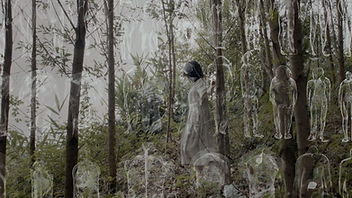
"dream(machine, human)" is a sensorial drift through layered realities. It can be interpreted as machine trying to understand or predict human dreams, machine and human dreaming together, a human dreams via a machine, or any other variations of the 3 words. The story takes place in ambiguous time, unfolding as machine-salvaged fragments of human memories, or a mythology of human demise and metamorphosis. -Lêna Bùi
"dream(machine, human)", single channel video, 14 min 35 seconds, 2025. Commissioned by VH AWARD of Hyundai Motor Group. A 10-minute version of the film has been shown at the 6th VH AWARD. The complete film will be released next year.
A Q&A with Lêna Bùi
Entering through Dream
Q: Your most recent work "dream(machine, human)" feels like both a filmic meditation and a speculative myth. The title itself suggests that the machine is dreaming of us, rather than the other way around. Could you share how you arrived at this concept of "machine dreaming," and why dream logic is such a powerful way for you to approach the human condition?
A: I like the word dream. It opens up all possibilities. It's not like fantasy where the imagined world follows certain rules that you've made up, or science fiction where certain science principals have to be respected. It can jump from one logic to another, or follow no logic at all, and yet it also holds the potential for a cross-over, a promised meeting point against all reasons, even if only in our sleep.
After working with video for 13 years I've come to see recorded images as a form of memory. The word "recording" itself has time embedded in it. Footages are always of the past, the medium of media itself is dated the moment it is made, so that even if we're talking of the future what we see will always be in the past as the image quality reflects the technology and aesthetics of its time, if not the actual recording of "reality" at a given moment. And so editing is a process of shifting through memories to construct something new. Whatever you're constructing, you will have to delve into memories in order to do this. So machine dreaming or machine remembering become very similar concepts to me.
AI images for me are also a type of warped memory, generated from processing countless images that are fed into the algorithms, images that are fed intentionally or wholesale scrapped from the internet and various databases. That's why certain narratives are perpetuated and amplified through AI. And so in a meta sense my film can be seen as science fiction, of machines taking a stab at constructing a reel from the prompt "human dreams," dream here meaning either that brain activity while asleep, or our conscious and unconscious desires.
On Dreams as a Method
Q: Across "dream(machine, human)" and earlier works like "Circulations" and "Kindred", dreams and dreamlike states appear as recurring strategies. Do you think of dreams as a kind of research method, an unconscious archive, or perhaps—as Freud and later philosophers proposed—a way of staging our deepest cultural anxieties and desires?
A: I agree more with Jung than Freud's analysis of dreams but I will not go into how dreams are interpreted. I'm more interested in what they can do as a method to crossover into a different kind of order and force acceptance of all absurdities. It allows both the maker and the audience to suspend their disbelief and accept certain fantastic premises. It can be lazy in this sense, because you don't need to justify why something is as is. But at the same time it allows a lot of freedom and I strive to be free.
As with any method, I'm still learning how to finetune this language, to be free but not plunge into senselessness. To dream with a sense of direction, to be absurd with purpose, and then to depart from purpose, taking flight using intuition as fuel–a kind of flight made possible only if my intuition already has enough built-in logic shaped through time and experience.
I'd also like to point out that the visual language in my film is often realistic, or documentary-ish, and not what you would expect of a dream. While it's a language that still needs refinement, I like this state of being neither this or that, of being between genres, not neatly placed.
Mythology and Shared Motifs
Q: In "dream(machine, human)", you weave together images of snails, termites, and human rituals with echoes of Khmer and Tai circular dance. These gestures seem mythological, connecting human life with other forms of being. What draws you to mythology as a parallel to dreams? Do you see them as different registers of the same impulse to grapple with life, death, and renewal?
A: I will quote Joseph Campbell here because I cannot articulate myth any better.
"What is a myth? The dictionary definition of a myth would be stories about gods. So then you have to ask the next question: What is a god? A god is a personification of a motivating power or a value system that functions in human life and in the universe–the powers of your own body and of nature. The myths are metaphorical of spiritual potentiality in the human being, and the same power that animate our life animate the life of the world. But also there are myths and gods that have to do with specific societies or the patron deities of the society. In other words, there are two totally different orders of mythology. There is the mythology that relates you to your nature and to the natural world, of which you're a part. And there is the mythology that is strictly sociological, linking you to a particular society. You are not simply a natural man, you are a member of a particular group."
Which mythology you choose to borrow from reflects the world-order you want to articulate. Is it a story of belonging to the earth, or is it a story of the subjugation of nature and man apart from everything else. It is fairly clear which order of mythology I subscribe to. And in doing so I'm trying to reconcile this alienating feeling I sometimes experience in the urban landscape and with my current lifestyle. The intense disconnection with my surroundings and a deep sense of loneliness.
In mythology, there is not just harmony but often violence because life itself is inherently violent and death is an inevitability to sustain life. Myths are a way to help us grapple with life, death, and renewal, and dreams are often used as a tool within mythology to achieve this. In dreams, things important to us come in images as symbols and metaphors.
On Gender and Reproduction
Q: One striking moment in "dream(machine, human)" is the mother–daughter conversation about happiness and having children. You've spoken about your discomfort with these cultural scripts of women's sacrifice, and your choice to counterbalance them with images of hermaphrodite snails. Could you expand on this decision? How do you negotiate, in your work, between reflecting dominant norms and unsettling them?
A: I don't think an average viewer will look at snails and think "ohh hermaphrodite", so this is not at all something apparent. Rather than something grand like unsettling a dominant norm, it's probably more of a joke to myself, a gentle reminder that nature has invented many other ways of being and for life to continue.
The conversation between mother and daughter was included because it causes me discomfort. It's a narrative both men and women can relate to in many parts of the world, especially Asia. To most people having kids is a natural course of life, that you should want that. Why is this? Is it our social construct, a certain kind of insurance for old age, or genetic programming? Are our children a manifestation of "Life's longing for itself" as Kahlil Gibran puts. But somehow this phrase "Life's longing for itself" is comforting in that it puts life as this all encompassing force that sweeps through everything, human and non-human.
I just read Ursula K. Le Guin's "The Left Hand of Darkness", in it she imagines Gethen, a planet populated by ambisexuals, androgynous beings both masculine and feminine, who share equally the burden of child birthing. Who takes on the role of the mother is spontaneous with each period of copulation, and thus their society is not arranged in binary terms like on Earth, with clear divisions between the sexes. It's a really interesting premise and much of the book tries to elaborate on these differences, but I am left with a vague imagination of another world order but not really quite a clear understanding of how that actually works.
We are firmly bound by the limitations of our body and experience and it is very difficult to imagine being anything other than ourselves. But for me it's a consolation to see other forms of life exist, to know that there are other ways to be and that we have the power of imagination to draw upon.
One other thing I like about crossing species or going beyond human is that it allows us to address certain fundamentals of life without being constrained by human constructs such as race, religion, national boundaries, and so forth.
From Dream to Practice
Q: You alternate between making films and making silk paintings—two very different modes of working. Could you talk about how these two practices speak to one another? Is painting a way of grounding yourself after the intensive research and planning of film-making, or do you see the two mediums as exploring similar questions from different angles?
I'm so fortunate I can switch back and forth between these two modes of working that I enjoy equally. Painting for me is a very inward and meditative process, where my body becomes a sort of medium. It's a very honest, direct, bodily activity, where I allow my unconscious to articulate itself. Of course there are certain overarching thoughts that I work with but mostly I paint without making sketches and let the work unfold as I go. So the images are directly influenced by my mood and even the weather.
Video-making is a bit more of an outward endeavor, it involves a lot of people and interaction with the world. The editing process becomes more inward, but the material, being recorded images, is something taken from the world and reassembled. So the process is a merge or collage between personal aspirations and memories of the world.
However, structurally these two very different modes of working are converging. My paintings are becoming filmic and my videos more abstract.
Ultimately I'm interested in working holistically with space. To not just contain fragments of imagination in a video, a painting or an object but to expand that idea into space, not as spectacles but in details and mood.
Beyond the Human
Q: In "dream (machine, human)", AI-generated images blur the line between human and non-human. In "Circulations", souls are imagined as multiple beings moving through a body. In both cases, the "human" is never singular or stable. You wrote that you wish to make works that express "a worldview that is not entirely human-centric." What would you imagine such a worldview look like? And what role can art play in shifting perception away from human centrality toward a more posthumanist, entangled sense of life?
A: For me being singular is a much more strange concept than being plural. Anyone who speaks a few languages notices that your mannerism and expressions change a bit depending on which language you're using. And if you grow up in different cultures you intuitively adjust your actions depending on context. This is not to say we are fickle and constantly changing entities, but I'd say we have a wide range of ways of being, and many thoughts that do not necessarily agree with each other. A human being is a kind of abyss, very complex and entangled. I accept this and expand on it instead of fighting for unity or purity.
It's hard enough understanding what being human means, and even more futile to try and understand anything other than human. For example, we can work out the mechanism of how trees photosynthesize or exchange nutrition through their root systems, but we can never quite imagine the language of trees, because whenever we imagine anything non-human "talking," they have to talk in our tongue, and in adopting our language they are anthropomorphized. But imagination is the first step to empathy, it is also the only mode that we can expand ourselves.
Trajectory and Future Directions
Q: Finally, looking at your trajectory—from works on animal–human relations in "Voracious Embrace", to community-based projects like "Sacred Water", to your more recent explorations of mythology and AI—what threads do you think have remained constant? And what directions are you most compelled to pursue now?
A: I've never worked on something that doesn't interest me. So all of the threads in my past works are still in my mind, still looping back and forth interweaving with newer works. The work that is "complete" is a product of deadlines and practical constraints, but the interests have never been resolved because what is articulated is fragmentary and unsatisfactory. I always think I can do better after I've completed a work. But it's only in making the work that I understand my thoughts and shortcomings.
So I'd say what I've always strived for is language—a language that is clear and porous, at the same time, fluid but structured.
[About]
Lêna Bùi (b. 1985, Vietnam) lives and works in Ho Chi Minh City. She graduated from Wesleyan University in 2007 with a BA in East Asian Studies and has been based in Vietnam since 2009. Her practice spans drawing, video, and other media, often beginning with everyday anecdotes to explore the profound effects of rapid development on human relationships with nature and the environment. Her work reflects on the intangible dimensions of life—faith, death, and dreams—and how these shape human behavior and perception. For Bùi, making art is a process of articulating questions and yearnings, asking: how do we rely on and separate ourselves from nature? How does history shape the present, and what of the present foreshadows the future?
Her works have been shown in a number of exhibitions and spaces such as the 15th Shanghai Biennale, China (2025); Galerie Urs Meile, Switzerland (2025); the 6th VH AWARD at House of Electronic Arts Basel, Ars Electronica and Hyundai Motorstudio Beijing (2025); Bangkok Art Biennale, Thailand (2024); Galerie Bao, France (2024); Nguyen Art Foundation, Vietnam (2024); Asian Film Archive, Singapore (2023); Jeju Biennale (2022), Asia Culture Center, South Korea (2021); Sharjah Art Foundation, UAE (2018); among others.


The Future Loop
ISSUE NO.2
Country X -
Metaphysical
Cartography
for the Future
ISSUE NO.1
The Artist as Scientist: Resilience and Healing in Lai Dieu Ha's Practice
ISSUE NO.2

From Hanoi Train Factory to Venice Grid: In Conversation with Trung Mai about The Architectural Paradox of Ephemerality and Eternity
ISSUE NO.1

Seeing Beyond Systems: Representation, Identity, and Resistance - In Conversation with Diane Severin Nguyen About A New Way of Seeing
ISSUE NO.1
On Dream(machine, human), Q&A with Lêna Bùi
ISSUE NO.2
The Future is Behind Us
ISSUE NO.3